

We Scraped Every Division I Staff Directory. Here's What 68,000 Athletic Department Employees Tell Us About the Arms Race.
Published June 12th, 2026
By Greg Chick of NILNomics
There is no single public database of who works in college athletics. No central registry of how many people it takes to run a Power 4 athletic department, what they're called, or what they do. The NCAA doesn't track it. The conferences don't publish it. The EADA reports total expenditures, but not headcount.
So NILNomics built one.
The Scrape
NILnomics developed an automated web scraper that visited the staff directory page of every Division I athletic department website — 368 schools — and extracted every name, title, department, email, and phone number it could find. The result: 68,423 individual staff records, the largest dataset of its kind ever assembled for college athletics.
Getting there wasn't straightforward. Every school's website is different. Some render tables in clean HTML. Some use JavaScript frameworks that don't load data until a browser clicks a button. Some bury staff inside iframes, Power Automate widgets, or Sidearm Sports card layouts. Our scraper used Selenium to handle dynamic pages, built custom parsers for Arizona, Temple, Tennessee Tech, Georgia Tech, and Clemson, and fell back to headless Chrome when standard HTML parsing failed.
The result is a categorized, conference-tagged dataset covering approximately 98% of Division I athletics. What follows are five findings from this data that tell the story of how college athletic departments have become corporate enterprises.
1. Football Is a Company Within a Company
Before we talk about the back office, let's ground this in what D1 athletic departments actually look like on the sport side.
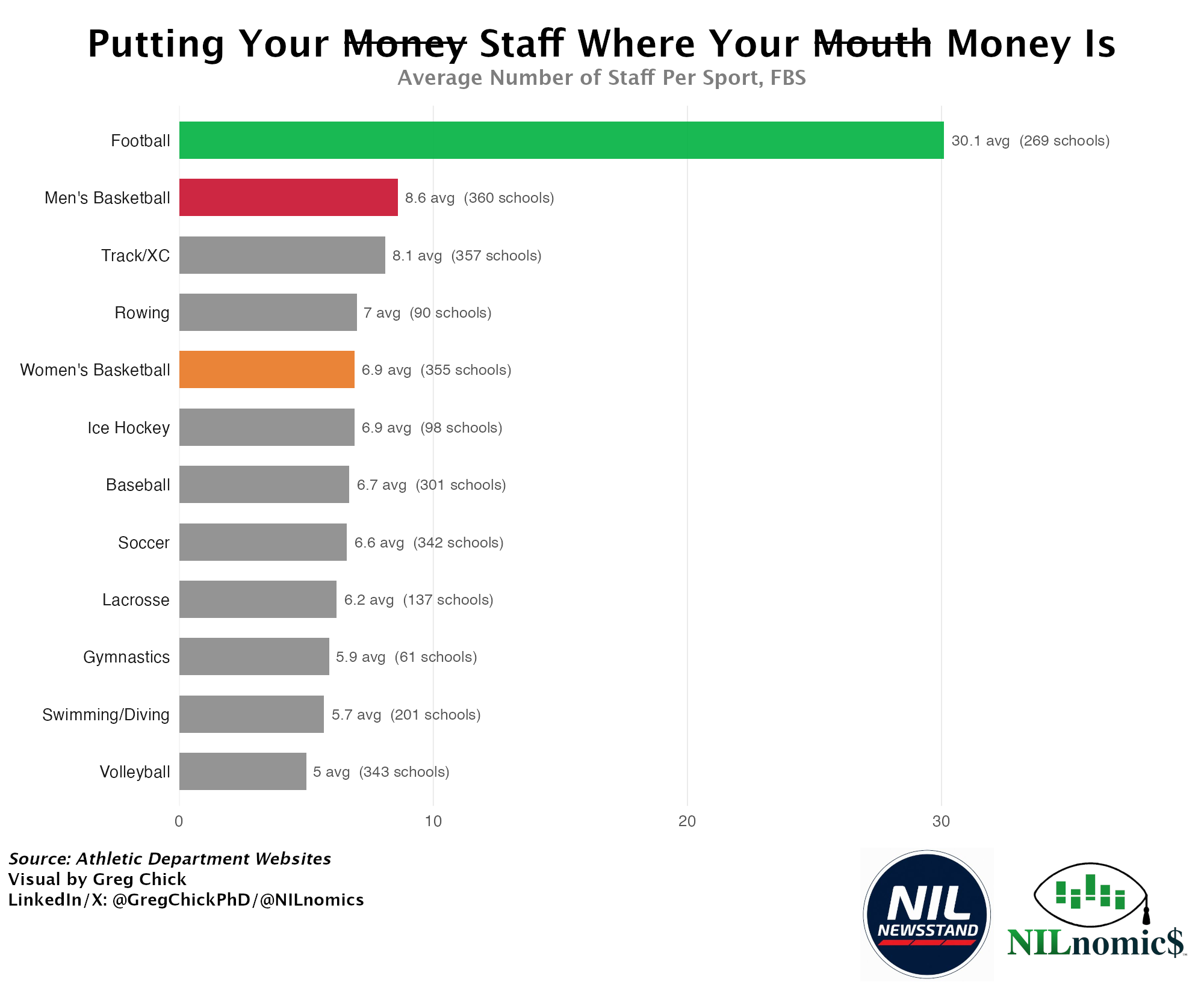
Football averages 30.1 staff per school where it exists — coaches, analysts, quality control, recruiting coordinators, player personnel, creative directors, strength staff embedded in the program. Men's Basketball is second at 8.4. Women's Basketball is third at 6.6. Every other sport falls below 5.
This is a 3.5-to-1 gap between the largest and second-largest sport. In SEC football programs, the average rises to 66 staff dedicated to a single sport. Georgia runs 120 people in its football operation alone — more than the entire athletic department of most mid-major schools.
Football doesn't just get the most resources. It operates on a fundamentally different organizational scale than anything else in the building.
2. The Org Chart Has Exploded
College athletic departments have borrowed the corporate playbook — and they're not being subtle about it.
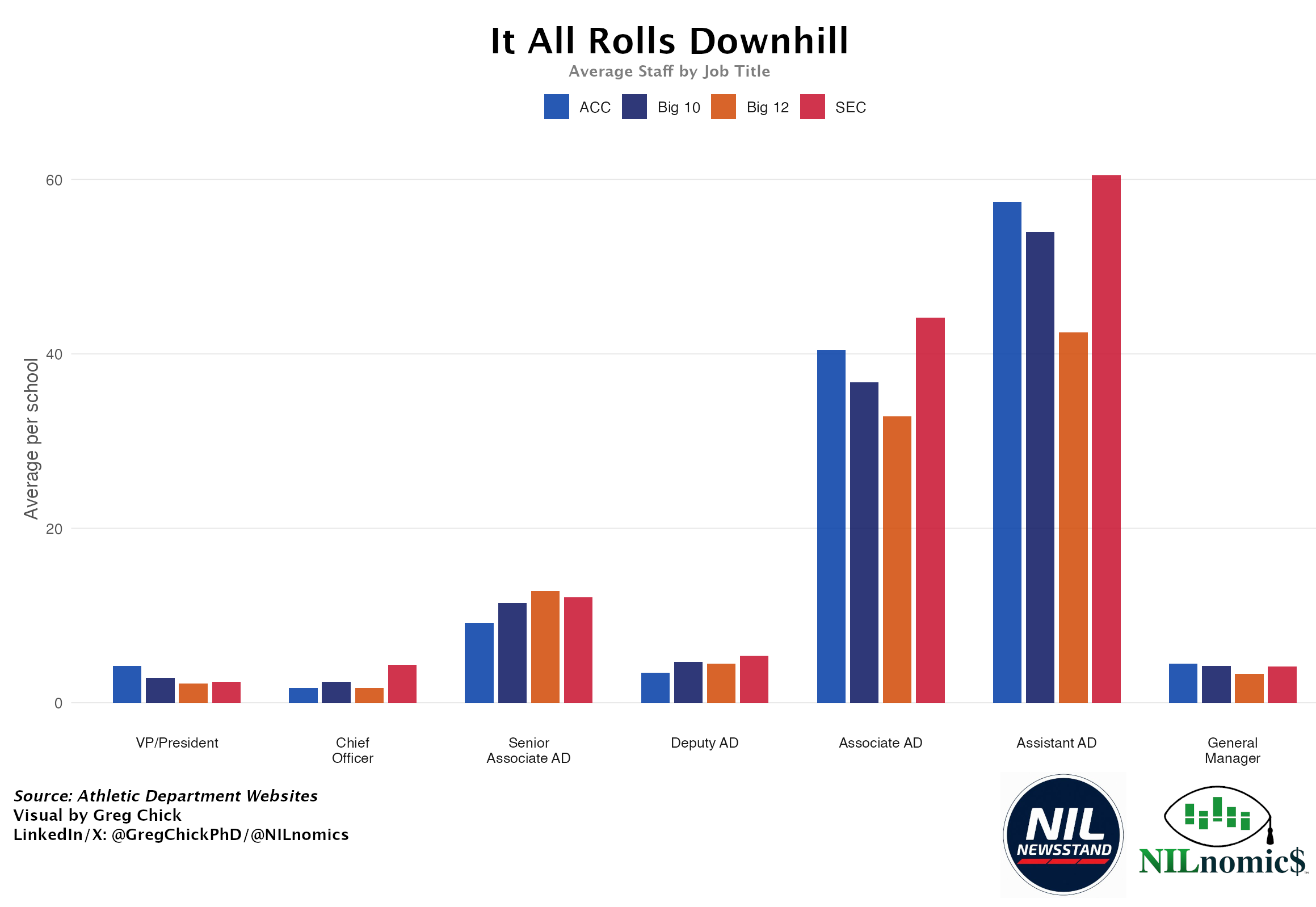
This chart shows the average number of people holding each title tier — VP/President, Chief Officer, Senior Associate AD, Deputy AD, Associate AD, Assistant AD, and General Manager — at Power 4 schools.
The SEC leads at every level. The Assistant AD title is where the real inflation is happening: SEC schools average over 40 people with some version of "Assistant Athletic Director" in their title. Associate ADs add another 25–30. Layer on Senior Associates, Deputies, Chiefs, and VPs, and the average SEC school has more than 100 people with an AD-level or executive title.
Chief Officers have arrived in college athletics in force: Chief Revenue Officers, Chief Financial Officers, Chief Operating Officers, Chief Commercial Officers, and — in at least one case — a Chief Hospitality Officer. These weren't titles that existed in college athletics a decade ago. They're borrowed directly from professional sports and Fortune 500 org charts.
3. Some Schools Have More Administrators Than Some Schools Have Employees
Zooming from conferences to individual schools makes the scale even more striking.
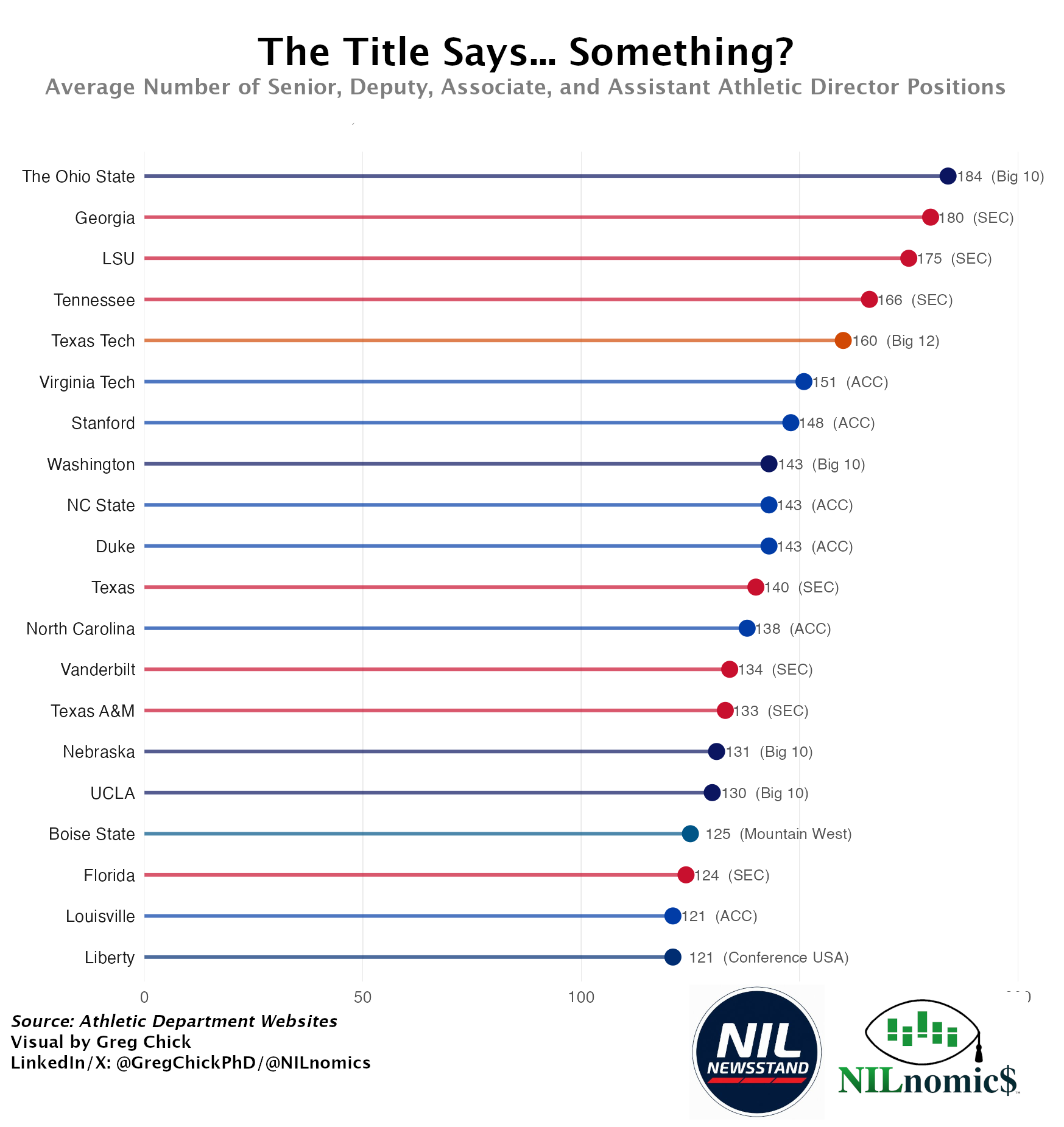
Ohio State, Georgia, and LSU each have more than 155 people carrying an AD-level title — Senior Associate AD, Deputy AD, Associate AD, or Assistant AD. That doesn't include directors, coordinators, managers, or any sport-specific roles. That's purely the administrative hierarchy.
For context, the entire athletic department staff at Mississippi Valley State is 36 people. Ohio State has more than four times that many administrators alone.
Liberty, a Conference USA school, appears in the top 20 at 113 AD-level titles — a striking outlier for a school outside the Power 4. The remaining top 20 is entirely SEC and Big Ten, confirming that the title inflation phenomenon is concentrated in — but not exclusive to — the wealthiest programs.
4. The Revenue Arms Race Is Being Fought With Headcount
Where are all these administrators going? Follow the revenue-generating functions.
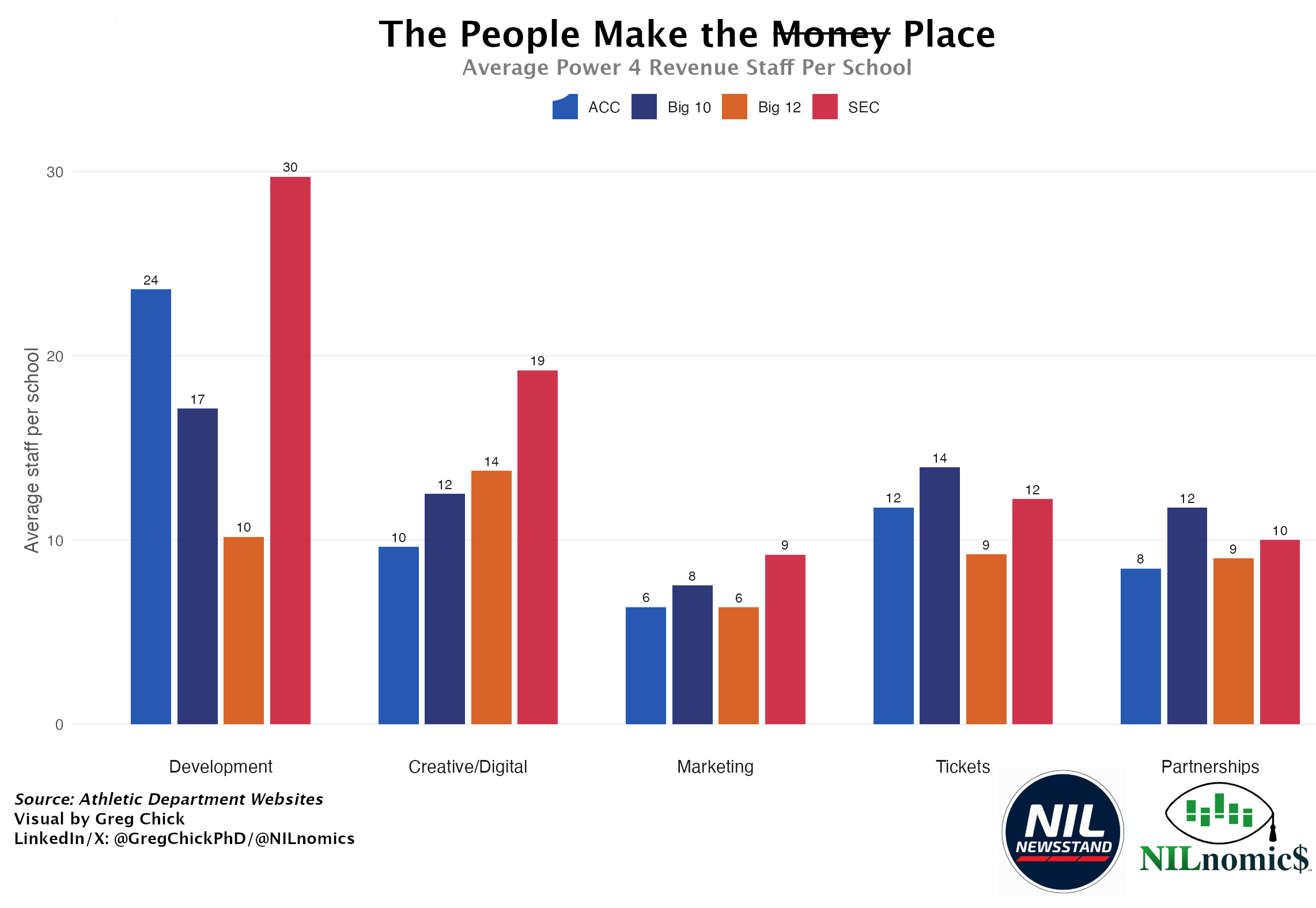
This chart compares Power 4 conferences on five revenue-generating functions: Development (fundraising), Creative/Digital/Broadcast, Marketing, Tickets, and Corporate Partnerships.
The SEC leads in every single category. Development is the most dramatic gap: SEC schools average 26 staff in fundraising and donor relations, compared to 10 in the Big 12. That's a 2.5x difference in the people raising money — which directly translates to a structural advantage in donor revenue, premium seating sales, and capital campaigns.
Creative and digital content is the second-largest gap. The SEC averages 19 content and production staff per school, reflecting the investment in in-house media operations that drive fan engagement, recruit attention, and sponsor value. The Big Ten is close at 16, but the ACC (13) and Big 12 (12) are falling behind.
These aren't cosmetic differences. The gap in revenue-side staffing is a leading indicator of the gap in revenue itself. Schools that invest more aggressively in the people who generate revenue create a compounding advantage that's very difficult to close.
What This Means
The data tells a consistent story: Division I athletic departments are becoming mid-sized corporations. The SEC and Big Ten are operating at a scale — in headcount, specialization, and organizational complexity — that separates them not just from mid-majors, but increasingly from the ACC and Big 12 as well.
The arms race in college athletics isn't just about facilities and NIL. It's about the 68,000 people who make the machine run — and the schools that are hiring faster, specializing deeper, and structuring more aggressively than everyone else.
Continue Reading Greg Chick's Exclusive NILnomics Research
This article is part of NILNewsstand Pro, where members receive exclusive NILnomics research, data-driven analysis, premium interviews, live discussions, and infrastructure trackers covering the business of the new era of college athletics.
- 📊 Exclusive NILnomics research & data visualizations
- 🎙️ Live discussions with Greg Chick and industry leaders
- 📈 Premium infrastructure trackers & databases
- 🏛️ In-depth analysis of NIL, revenue sharing & college athletics
- 🤝 Access to the NILNewsstand Pro professional community
